Transplant raspberry canes in spring or fall for better growth. A sunny spot with good air flow and well-draining soil can lead to bigger, healthier harvests.
To grow fruit in planters, see 12 Best Fruits and Berries to Grow in Containers.

Growing Raspberries

One of things I miss most about our old garden is the strawberries and raspberries. Both were (surprisingly) incredibly happy in that hard clay soil.
June meant mounds of fresh strawberries, and, just as they were finishing up, the raspberries would start ripening, providing fresh berries right through until August and then again in the fall (they were ‘everbearing’ which means they can fruit twice in the growing season.).
What started as a single raspberry cane (year one) gradually morphed into dozens of plants which, by year ten, bordered on invasive status.
On more than one occasion I set out to chop them back and remove some roots, only to find myself sitting on the steps to the deck, rethinking the whole thing as I slowly devoured yet another handful of giant, super sweet berries.
Yes, they can be aggressive growers, but it’s fairly forgivable when it’s a perennial food source that requires very little care.
Contents
Where to Grow Raspberries

Growing Conditions
- Light shade to full sun
- Soil that holds moisture but does flood (roots will rot)
- In-ground or containers
Pollination
- Flowers are self-fertile with assistance from insects (or you).
If you have seen raspberries in the wild you know they do well at edge of woodlands where their feet never dry out but the fruits receive sun.
Raspberries will tolerate a range of conditions from light shade to full sun so long as the roots have consistent moisture without getting waterlogged.
How to Transplant Raspberries

About Plant Patents
Some plants are patented and asexual reproduction is not permitted without permission from the patent holder. Patents and trademarks are usually listed on plant tags.
1Timing
When is the best time to transplant raspberries?
The best time to trasnplant raspberries is before or after fruiting to avoid interupting this year’s fruit production. Depending on what type you are growing, this could be spring or fall.
It’s easier to move rasberry canes when they are pruned but sometimes you just need to get the task done and cannot wait.
If you want to move them during fruiting, do your best to disturb the roots as little as possible and be sure to keep them well-watered in their new location.
This is the BEFORE picture of the raspberries I moved. They were really struggling in this spot by the fence, probably because of a lot tree roots underfoot and inadequate light.

2Prepare the New Bed
Get the new location ready before beginning your transplant.
Dig a hole approximately 18-inches wide by 12-inches deep and set soil aside for reuse.
I like to water the hole deeply before planting as well.
When I transplanted mine, I had prepared a bed with composted manure a year earlier, allowing it time to meld with the garden soil.
3Prune the Canes
With your raspberry plant still in the ground, cut the canes down to about 10-inches.
Advice varies (6 to 18″) but 10-inches has always worked well for me. When I trimmed mine, I also removed any dead canes.
Because I’ve trimmed them in spring, I do not expect to get any fruit until next year (on this year’s new growth).
You can also propagate raspberries using the layering method which I have described here.
4Dig Up the Canes

When digging up any plant for transplant, you want to bring as much of the original soil with it as possible.
This prevents any unnecessary disruption to the roots.
I found this easy to do in my old garden which had heavy clay soil. But here in my new sandy garden, all the soil falls away as soon as I lift the plant.
You don’t want to leave the bare roots exposed so either replant immediately or place the roots in warm water or damp soil and transplant as soon as possible.
Raspberry Suckers

Can I transplant raspberry suckers?
Yes. Raspberries spread by roots and the new plants that pop up are often called ‘suckers’. You can transplant them.
The key to success is, find a sucker at least a foot or two from the mother plant.
Mark the halfway point between the sucker and the mother plant, and dig there first, cutting that section of root in two.
This should give both plants enough roots to carry on.
Examine the Canes
It’s early spring as I’m doing this so there’s just a few tiny green shoots and leaf buds, but enough to make me think the plant will survive the move.
If there’s signs of new growth (and no disease present), it’s probably worth transplanting.
Here’s a few examples of the ones I opted to keep. This next one has leaf buds:

This one has a shoot forming from the base:

5Plant in New Location
Plant in the new location at the same soil depth as the original location.
Hold plant in position, spread out roots, and gently add soil, pressing it in place.
Water and top up soil as needed.

Spacing
Raspberries do best with good air circulation so you don’t want to crowd the plants.
I’m intending to grow mine on supports and prune them regularly so they can be planted just a few feet apart.
If you’re leaving them bushy, allow extra space.
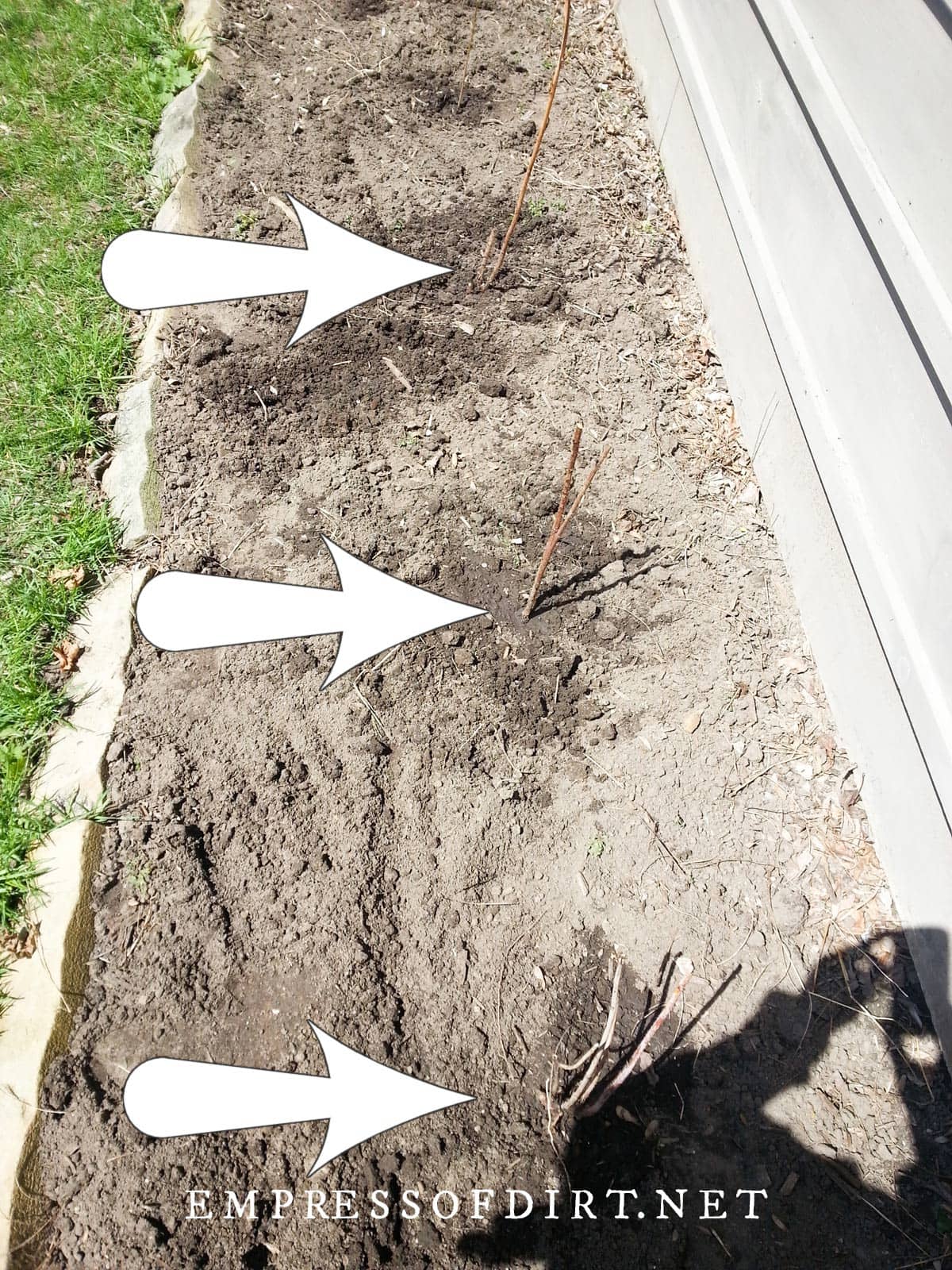
Water
Give the newly transplanted canes a good soaking. Fill in any air pockets with more soil.
During the growing season, keep the soil most (not dry or soaking wet).
6 Mulch
Add a layer of organic mulch to help retain moisture.

I used straw—and plenty of birds are making use of it too.
Raspberry Tips & Care

Single Harvest and Everbearing
Fruit Times & Pruning
Always remove dead, damaged, or diseased canes as soon as you notice them.
- Autumn bearing raspberries fruit in first year on current year’s canes.
- Cut canes down to ground in winter (for a lot of fruit, fall only), or
- Encourage summer and autumn fruit by only cutting canes by half: lower parts can then yield fruit (less fruit but two harvests).
- Summer bearing raspberries fruit in second year
- Cut canes after fruiting.
- Some summer varieties will need supports.
Red and yellow raspberries come in single harvest and everbearing varieties.
If you don’t know which type you have, just watch and note the flowering and fruiting times. Within a year you will know.
Single-bearing usually fruit in July (ish).
Sweetness
- SUPER SWEET Yellow raspberries are my favorite. They can be hardy to as low as zone 3 and for some reason the birds aren’t that fond of them. Bonus.
- SWEET Red raspberries are still nice and sweet, just not uber sweet like the yellow ones. Birds like these ones best.
- LEAST SWEET – Black raspberries don’t like anything lower than zone 5. The taste can be slightly tangy which makes these berries are excellent for baking.
Fall-Bearing Raspberries
Here are some varieties that fruit in fall:
* All Gold (my fave!)
* Anne
* Autumn Bliss
* Caroline
* Heritage
* Joan J
* Kiwi Gold
* Polka
In late fall after the leaves drop, just cut back all the canes that fruited. Easiest pruning ever!
Fruit and Fertility
Raspberries are self-fertile which means you don’t have to worry about getting male and female plants. The insects and wind will take care of business.
First come the flowers, and when those are finished, they transform into berries.
Feed
Add a new layer of compost or manure late fall or early spring each year to replenish the soil.
Support
To support or not to support, it’s up to you!
Some gardeners train the canes that will fruit in the current year on one side of a wire trellis, and next year’s canes on the other. Very organized!
Some plants, like the red and yellow varieties, are sturdy enough to grow fine without stakes or trellis. Others sprawl and do better with some support.
The goal is to have healthy plants that produce lots of fruit that is easy to pick. How you do it is your business.
No matter what, good air circulation helps reduce the chance of disease.
Resources
Recommended Books
I hope your raspberry transplanting is a success and there is lots of delicious fruit in your future.
~Melissa the Empress of Dirt ♛

How to Transplant Raspberry Canes
Supplies & Materials
- 1 Raspberry Plant
Instructions
- Prepare new location by digging 18" wide x 12" deep hole and watering deeply.
- Trim raspberry canes down to approximately 10-inches.
- Dig up plant and roots working at least 12-inches from plant all the way around and place in bucket. It's fine to trim away longer roots.
- Plant in new location by placing plant at original soil depth.
- Gently spread roots and cover with soil. Press into place removing any air pockets.
- Water deeply. Top up soil as needed. Add mulch to prevent soil from drying out.
- Keep watered (but not too much). New growth should appear in 2-4 weeks.
Jon Norman says
Hi, how long can I leave the canes out of the ground for once dormant? I have a major bindweed problem so need to move the raspberries while I deal with this…
Melissa J. Will says
So long as you keep the roots moist and don’t allow them to dry out, you’ve got time to work on that bindweed. I’d plant them in containers until you’re ready to plant them in the ground.
robert n turnbull says
great info … thanks
Roscoe Davenport says
I really enjoyed reading your articles on raspberries. I did want to make one comment on your pruning technique and timing. I live in the inland northwest spokane Washington and as a child my great grandfather always told me to wait until the last frost in the spring to prune the canes. His reasoning was that the plant is feeding the soil all winter extracting nutrients from the cane. Have you heard of this technique. I have a 12’x5′ raspberry garden that yields 30 to 40 gallons annually.
Melissa J. Will says
Hi Roscoe,
I think there’s some research looking at how the canes may send carbohydrates to the root area in early winter in preparation for dormancy during the winter. It’s the plant protecting itself, rather than “feeding” the soil. It’s an interesting topic–lots of plants including trees do things like this. This lines up with late winter being a commonly recommended time to prune a healthy woody plant.
Mary Breasted Smyth says
A friend gave me 27 raspberry canes, quite tall and sprouting leaves. It is just a couple of days after the first week in May. I am hoping ridiculously to have fruit from these canes even this year. My neighbor keeps bees and they do come up my hill to find my flowers. I really don’t want to cut down these tall canes as I transplant them. I will do that in the fall. I hope I am not making a big mistake. Your instructions are very helpful, but I wish I could actually talk to a person. Thanks! Mary B
Bob says
I am looking to transplant several canes. This was a helpful lesson.
Mangaliso says
Evening, is it necesarry to make holes underneath the flower pot when transplanting ràsberriés/ blueberries or cherries to enable the water to pass so that the plant can breath and avoid too much soaking or it doesn’t matter.
Melissa J. Will says
If it’s temporary (a few days or less), it doesn’t matter. I often place the roots in a bucket of **warm** water during the transplanting process.
Janice Johnston says
i live in Oregon and have willamette everbearing raspberries. They have lots of runners. Some are 4 to 5 foot tall. It is July and I havn’t had time to transplant the runners until now. This year the mature plants bearing fruit are developing yellow leaves before the fruit is ripe. then the leaves turn brown and the plant appears dead. My soil compacts easily and I might be watering them too much. Can I transplant the bright green runners at this time or should I wait until Fall. Shouldcut the taller ones
Melissa J. Will says
I would transplant now. No sense waiting if they need a different location. And, easy on the water. 🙂