Discover how seasonal changes guide plant and wildlife behavior—and why gardeners rely on phenology, often without realizing it, to plan and grow their gardens.
An example of how we garden according to phenology is by planting flower seeds according to best soil temperatures. The same goes for sowing vegetable seeds.
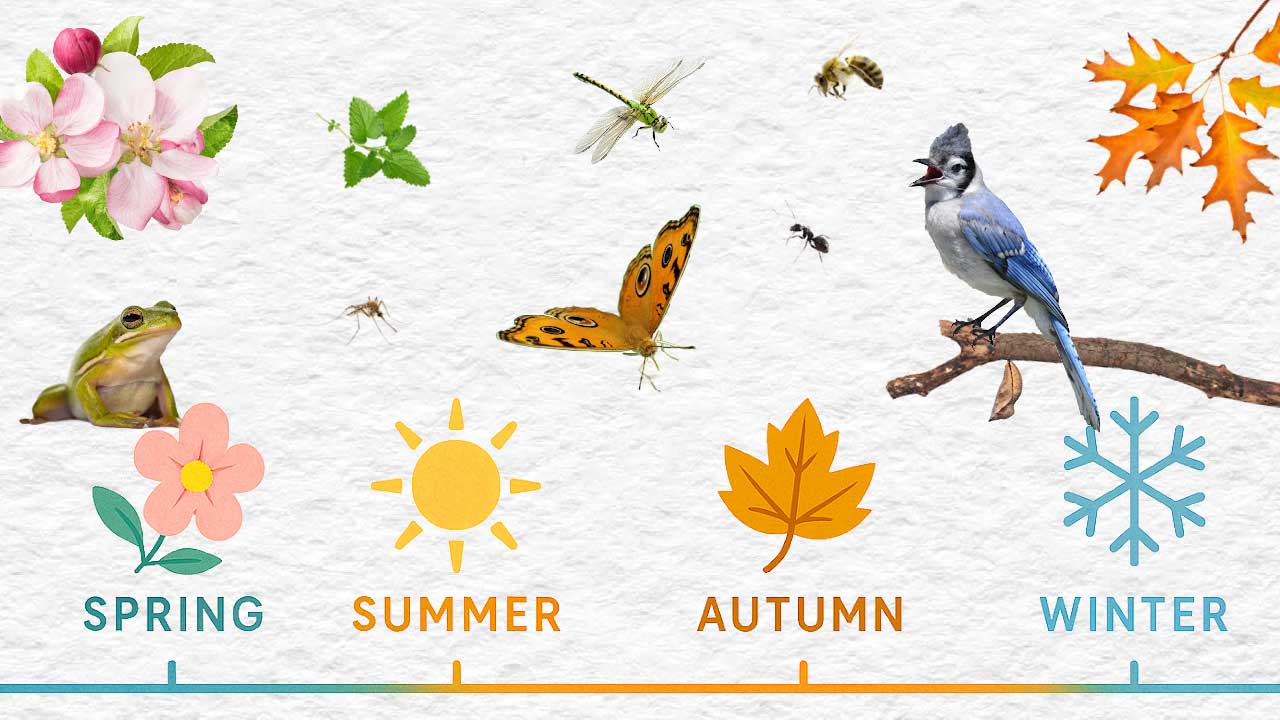
Garden Phenology
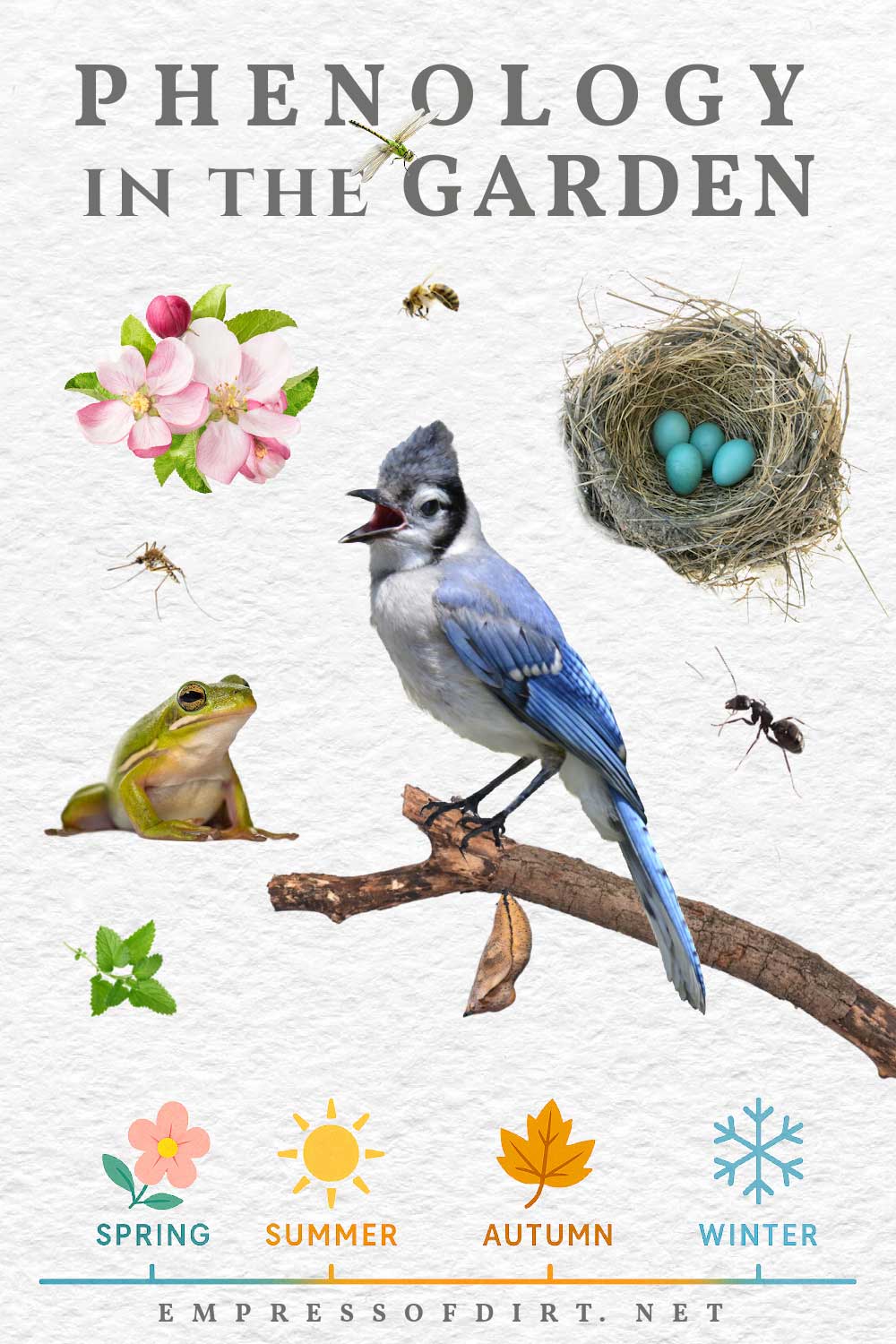
This article is based an episode from our podcast,
Two Minutes in the Garden, titled What is Phenology and Why It Matters.
If you prefer to listen to this content, see the podcast player in Resources below.
We’ve all sensed various changes in our gardens that made us think, “oh, it’s that time of year again.“
Maybe it the first whiff of lilacs blooming, or the hum of bees emerging from their winter slumbers.
At our house, a big milestone is the first (very loud) sounds of frog mating calls around our ponds or the first sighting of a ruby-throated hummingbird. And the first day the cicadas start blasting the airwaves.
Whatever it is for you, something triggers that familiar feeling that this always happens at this time of year. Not exactly the same time, but around the same time.
Sometimes we get those feelings from seasonal changes that don’t involve living things, like the first snowfall, or noticing how the sun is still up well past dinnertime. Those are well-known examples of seasonality—shifts in conditions mostly caused by the Earth’s tilt and orbit around the sun. And, unless you live at the equator, that’s why we have seasons.
Some seasonal events are highly predictable. For example, future sunrise and sunset times—for days and years to come—at any location on Earth can be calculated with precision.
Other events are not so predictable, as gardeners well know.
The last day of freezing temperatures each spring can come as a big surprise, not just to us but to plants and wildlife. We know the average day, but there’s a lot of variation from year to year.
Yet it’s these seasonal changes, mostly in temperature and amount of daylight, that trigger events or behaviors in the lifecycles of plants and animals. Flowering and fruiting times may be the most familiar to gardeners, but also a bird starting mating calls or an insect showing up for the first time this year.
And this is where we’ve stepped into the world of phenology.
What is Phenology?
Phenology is the seasonal timing of lifecycle events in living things.
Phenology is the seasonal timing of lifecycle events in living things, like plants and animals.
It’s when things bloom, leaf out, set seed, fruit, go dormant, migrate, reproduce and so on.
And these recurring seasonal events in living things are almost always tied to those seasonal shifts in temperature, daylength, or moisture which in turn cue phenological changes in plants and animals.
Phenology is about when things happen: the timing. And phenological changes in living things through the year help us mark the passage of time just as seasonality effects like sunshine and snow do. They’re the mileposts for our trip through the year.
As gardeners, we live in this phenological world both with our plants and with the wildlife in the garden. We plan around when we expect things to happen and observe when they do.
In her recent book, Phenology, Theresa M. Crimmins, a professor at the University of Arizona and director of the USA National Phenology Network, provides an array of interesting examples of interconnected phenological events. I’ve included some of them here.
Natural Lifecycles
Gardeners know well that our plants respond to temperature and daylight. What we see from plants and animals in the garden is different every month as average temperatures rise and then go back down and as the amount of sunlight increases and the total amount of light and warmth our plants have received accumulates.
A lot of common gardening experiences are examples of phenology. Even something as basic as when your lettuce bolts. Most gardeners have had this happen: one day it’s producing delicious leaves, and the next it’s putting all its energy into flowering and going to seed and the leaves become bitter.
We may not think of that as phenology, but that switch happens because the lettuce is responding to seasonal cues: increasing daylength and rising temperatures. Those cues tell the plant that its window for vegetative growth is closing and now it’s time to reproduce. Even though we see bolting as a nuisance—and the process may be hastened by extreme temperatures—it’s really just a natural part of the plant’s lifecycle. A phenological shift.
This kind of seasonal timing shows up all over the garden.
- Cool-season crops thrive in early spring and fall because that’s when the conditions match their needs.
- Warm-season crops just sit there (or suffer) if you plant them too early but then spring to life once the temperature tells them it’s time.
And it’s not just plants. Insects, birds, fungi, frogs, even microorganisms, all follow their own phenological patterns, shaped by the seasons and their surroundings.

Seasonal Timing
And almost everything about gardening depends on phenology. The whole idea that certain plants bloom in certain months, or that particular garden tasks make more sense in spring than in summer, for example, is grounded in phenology.
Biological events happen in a certain order each year. Not on exact dates, but in a familiar sequence.
Month-by-month gardening calendars are very popular: what to plant, what’s blooming, what’s likely to show up next, and those only exist because of phenology. They’re based on the idea that biological events happen in a certain order each year. Not on exact dates, but in a familiar sequence.
That’s the kind of planning gardeners rely on. We don’t know the exact day the tomatoes will ripen or the monarchs will arrive, but we have a general idea.
We can’t just pick a date on the calendar and say, “we’ll harvest on August 15.” We have to watch for nature’s cues. And thanks to reliable seasonal patterns, we have a rough idea of when we need to start paying attention. That kind of inexact predictability is what makes planning possible in the garden.
Some years we get big surprises. Apparently the plants and wildlife didn’t read our gardening calendar. But, generally, there’s a lot of predictability.
Without phenology, there wouldn’t be much to plan for or much rhythm to the season. Gardening wouldn’t feel seasonal in the same way.
So even if we’ve never used the word “phenology”, we’ve been living by it.

Phenological Matches & Mismatches
You’ve also probably noticed connections between the timing of events in different plants and animals. Maybe one plant always seems to bloom just a bit before another, or certain insects or birds or other wildlife appear around the same time that a particular plant flowers or fruits.
Phenological relationships form the web of life.
This is the web of life, and we depend on those connections.
For example, insect-pollinated plants bloom at a particular stage of their lifecycle which will have seasonal triggers. And, at the same time, those insects are only effective pollinators for a particular part of their lifecycle. Successful pollination needs those two events to overlap.
Something happening later or earlier than we’ve come to expect can have a chain of consequences that go beyond just one species. And that’s what ecologists call a phenological mismatch — when two species that normally depend on each other are no longer in sync.
Maybe a plant blooms before the insects that usually pollinate have appeared. Or insects come and go before the birds that feed on them have arrived. Or a tree sets fruit earlier than usual, but the animals that rely on those fruits aren’t ready yet or have already moved on.
These relationships work great when the timing lines up. But when one species adjusts to new conditions and the other doesn’t— or can’t—the result can be a mismatch. And even a small shift in timing can have ripple effects.
Teresa Crimmins gives several examples from recent studies. One of the clearest is in migratory birds. Some short-distance migrants adjust their spring arrival as temperatures rise. But many long-distance migrants cue their migration based on daylength instead of temperature. And that doesn’t change. That means the short-distance migrants continue to have good timing while the long-distance ones may arrive too late, after the insects they rely on have already peaked. And when that happens, their nesting success drops.
It’s the same thing with pollinators. If a warm spring causes a plant to flower earlier than usual, but the insect pollinators haven’t emerged yet or aren’t active in large numbers, pollination may fail. For annual plants or early-bloomers that have a short flowering window, that failure can mean no seeds, no fruit, and no next generation.
More and more, these changes in timing, and the mismatches they can cause, are being linked to climate change and rising temperatures.

Phenology and Climate Change
Phenology has become one of the clearest biological indicators of a warming world.
Because so many plants and animals time their life cycle events based on temperature, rising temperatures mean those events are happening earlier, sometimes dramatically so.
There’s now a large body of research showing that, around the world, spring events are happening earlier than they used to.
Crimmins cites a global average of about four days earlier since the 1980s but in many places the shifts have been far greater.
- In New York State, tulip trees now flower nearly a month earlier than they did in the early 1800s.
- In Massachusetts, yellow wood sorrel blooms more than 30 days earlier than it did 150 years ago.
- In some parts of Europe and Asia, leaf-out in trees has advanced by more than two weeks since the 1980s.
And it isn’t limited to plants.
Insects, birds, amphibians, mammals—all kinds of wildlife are showing shifts in their seasonal timing. But not at the same rate and that’s one of the key challenges.
Crimmins explains that cold-blooded animals like insects and amphibians are especially sensitive to temperature and tend to show the biggest shifts.
- Some frogs in South Carolina now breed nearly two months earlier than they did in the 1970s.
But it’s not just cold-blooded animals.
- Some birds are starting their breeding seasons weeks earlier than they did in the past.
And that difference creates opportunities for mismatches to develop.
The spring green-up moves forward, insects emerge earlier but if some birds arrive on their old schedule, their food supply has peaked before they get there. That in turn affects how many offspring they can raise and the overall population numbers.
So rising temperatures have reshuffled the calendar that plants and animals have relied on for thousands of years. And because so much of gardening depends on that seasonal calendar, we’re bound to notice it too when it starts to drift.

Warming Cities
Urban areas can also have an added impact on phenology. Cities and suburbs don’t follow the same seasonal rhythms as surrounding rural areas. They’re often a degree or two warmer, with an even bigger difference at night, once the sun has gone down. There’s still heat coming from things like pavement, buildings, and waste energy, creating what’s called an urban heat island.
Researchers have found that vegetation in large urban areas can green up four to nine days earlier and go dormant two weeks later than in adjacent natural areas. Early spring bloomers, annuals, and insect-pollinated plants tend to show greater advancement in flowering than perennials, mid- or late-spring bloomers, and wind-pollinated plants.
Light Pollution
Along with temperature, light pollution is also an issue. We recently discussed the effects of artificial light on fireflies including light from streetlights, buildings, and cars, for example, primarily in urban areas. That light also has an effect on phenology. Some plants need a certain amount of darkness to enter dormancy or flower at the right time. When there’s too much light at night, those cycles can be disrupted.
Researchers have found that some trees in brightly lit urban areas don’t drop their leaves at the usual time or hold onto them long after they should have gone dormant. That can interfere with their natural rest cycles and leave them vulnerable to damage.
Again, when plants shift their timing, the insects and birds that depend on them may not be able to change with them. Which means that cities can become hotspots for phenological mismatches.

Effects on Humans
These phenological shifts can have effects on us too. A big, foreseeable issue is how mismatches between plants and pollinators will affect food sources we rely on.
Another simple example is seasonal allergies. As temperatures warm, spring arrives earlier. Many wind-pollinated plants, which includes most trees in temperate areas and grasses, bloom earlier and sometimes longer. That means more pollen in the air starting sooner in the year.
These are the plants that cause most seasonal allergies because their lightweight pollen is carried by the wind instead of by insects. So, while a warm early spring might sound nice, for allergy sufferers it could mean that symptoms start weeks earlier although you may make up for that later in the year.
Record Your Observations
We know that phenology is changing—shifting in ways that affect plants and animals and the relationships between them. But for researchers to really understand why these changes are happening and what they mean, they need a lot more data from many locations and over many years.
And that’s something we can each help with.
We’re out there observing phenology all the time, not just in the garden but in our neighborhoods as well. If we take a little more time to share those observations, and if hundreds and thousands of people join in, that data can be valuable to researchers.
We recently did an episode of our podcast on how easy it can be for gardeners to become naturalists (you can listen to this episode below), and that includes sharing phenological data.
In that episode, we mentioned the app iNaturalist. It’s not focused specifically on phenology, but it collects time-stamped and location-tagged observations of plants and animals around the world. And those can be used to study changes in seasonal timing.
Theresa Crimmins’s organization, the USA National Phenology Network, has an app called Nature’s Notebook (available in the Google Play Store and the Apple App Store) which is specifically set up to collect phenological data from across the U.S. and Canada.
You choose a plant or animal species to observe, note things like first leaf, first flower, or when you hear the first bird calls, and submit those observations through the app or website. That one’s just for U.S. and Canada, but there are volunteer phenology observation initiatives in many other countries too.
And over time, those small observations add up, helping scientists track how phenology is changing, where it’s changing fastest, and what the consequences might be.
Even if you’re not ready to use an app and share your information, it’s worthwhile to keep records for your own reference. A simple document, spreadsheet, or calendar will do. I have a Google calendar I named Phenology for this purpose.
First days are always the easiest place to start—you know them as soon as they happen.
- First day various plants bloom including trees and flowers.
- First bee or earthworm or cicadas
- First sightings of migratory birds, butterflies, or dragonflies
- First day of harvest for different fruits and vegetables
- And, of course, first frost.
Last days are trickier and subject to change, but you can track those too.
Things like “the irises are blooming early this year” or “I haven’t seen any monarchs yet” become valuable over time. When shared, those apps turn your observations into data that can help researchers and ultimately help us all make better decisions for gardens, ecosystems, and the species that depend on them.
Resources

Phenology (The MIT Press Essential Knowledge series)
by Theresa M. Crimmins
On the timing of seasonal activity in plants and animals, the impact of climate change, and what each of us, as everyday phenologists, can do to help.
Tools
Listen
~Melissa the Empress of Dirt ♛